What Forms Do Estheticians Need? Complete Client Forms Checklist
August 26, 2026
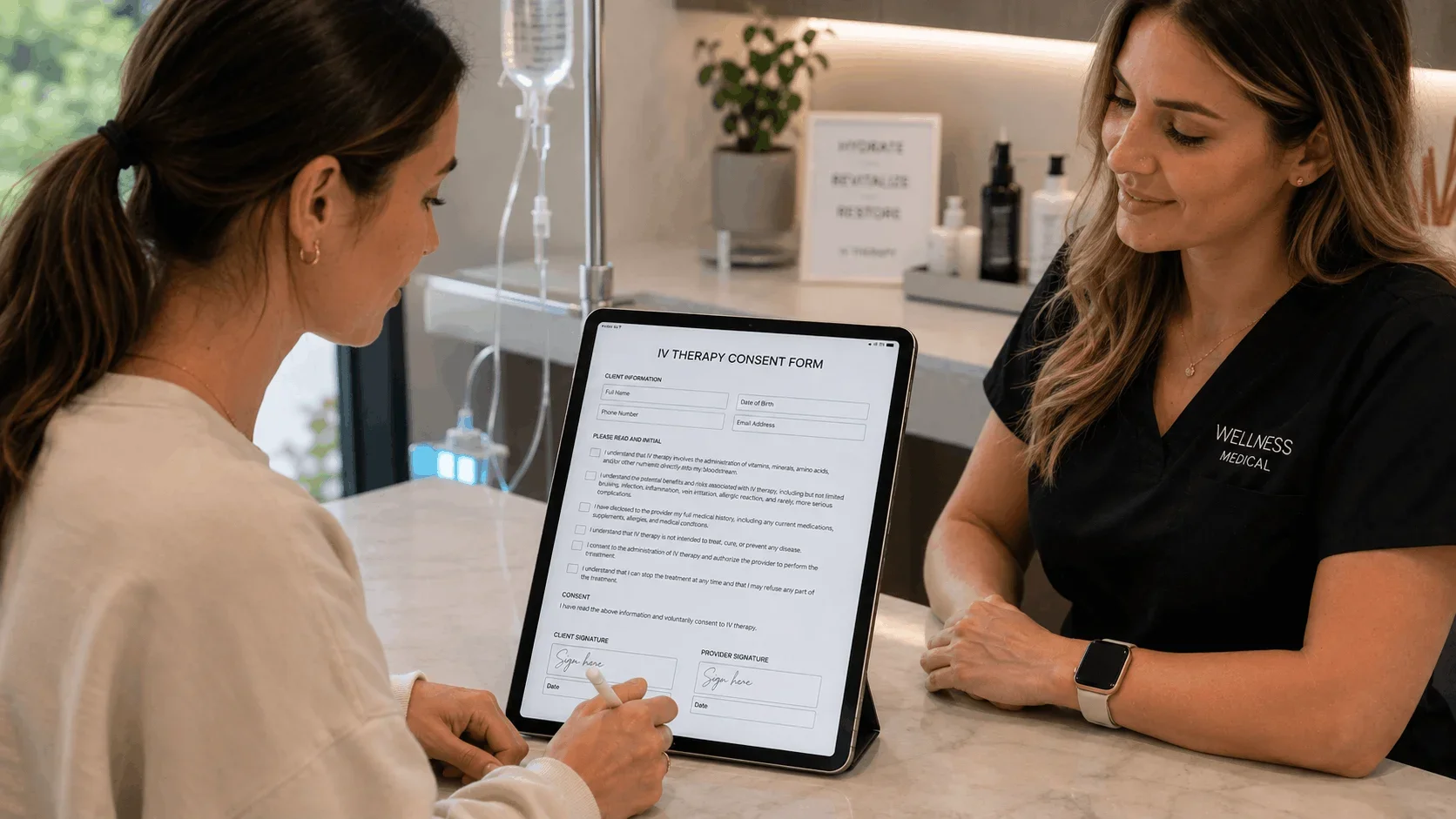
Running an esthetics business involves more than delivering great skincare treatments. You also need a reliable way to collect client information, identify potential contraindications, document informed consent, track treatments, provide aftercare instructions, and keep a record of what happened during each appointment.
That is where esthetician client forms come in.
A new client may need to complete an intake form before their first appointment, while treatments such as chemical peels, microneedling, dermaplaning, waxing, or laser hair removal may require their own treatment-specific consent forms.
There isn't one universal set of forms that applies to every esthetician. What you need depends on the services you provide, your location, licensing rules, insurance requirements, and how your business operates. Current esthetician intake and consent forms commonly collect contact details, skin concerns, allergies, medications, previous treatments, current skincare products, treatment goals, consent, and signatures.
This guide breaks down the most useful forms for estheticians and explains when to use each one and what it should include.
Esthetician client forms checklist
Here is a practical starting point for an esthetics business:
Form | When to use it | Priority |
|---|---|---|
Client intake form | Before a client's first appointment | Essential |
Esthetician consultation form | Before deciding on a treatment plan | Essential |
General treatment consent form | Before providing skincare services | Essential |
Treatment-specific consent form | Before higher-risk or specialized treatments | Essential for applicable services |
Treatment record | After every appointment | Essential |
Aftercare instructions | After treatments requiring specific home care | Recommended |
Photo consent form | Before taking or using client photos | Recommended |
Patch test form | When a product or service requires testing | When applicable |
Minor parental consent form | When treating clients under the applicable age of consent | When applicable |
Cancellation policy acknowledgement | When clients book or begin treatment | Recommended |
Client information update form | Periodically or when circumstances change | Recommended |
Incident or adverse reaction form | If an unexpected reaction or incident occurs | Recommended |
You do not necessarily need twelve separate documents. Some information can be combined into a well-designed client intake and consultation process. However, treatment-specific consent should remain clear enough that clients understand exactly what procedure they are agreeing to.
1. Esthetician client intake form
The client intake form is usually the first form a new client completes.
Its purpose is to give you the information you need to understand who the client is, why they are visiting, and whether there are factors that could affect their treatment.
A good esthetician intake form may collect:
- Full name
- Date of birth
- Phone number
- Email address
- Emergency contact
- Primary skin concerns
- Allergies and sensitivities
- Current medications
- Relevant medical conditions
- Pregnancy or breastfeeding status where relevant
- Current skincare products
- Prescription skincare products
- Recent cosmetic procedures
- Previous reactions to skincare products or treatments
- Client goals and expectations
Current esthetician intake templates typically combine contact information with medical history, skincare routine, allergies, medications, previous procedures, and treatment goals.
The goal is not to ask every health question imaginable. Ask for information that is relevant to the treatments you provide and that can help you identify whether a treatment should be modified, postponed, or avoided.
When should clients complete an intake form?
A client should normally complete an intake form before their first treatment.
You should also provide a way for returning clients to update important information. Medication, pregnancy status, skincare routines, allergies, health conditions, and recent cosmetic procedures can change over time.
A simple question such as “Has anything changed since your last appointment?” can become part of your repeat-visit process.
2. Esthetician consultation form
An intake form gathers information. A consultation form helps turn that information into a treatment plan.
During the consultation, an esthetician may evaluate the client's skin, discuss concerns, clarify expectations, and decide which treatment is appropriate.
An esthetician consultation form could include:
- Main skin concerns
- Treatment goals
- Skin type
- Visible sensitivity
- Dryness or dehydration
- Oiliness
- Acne or congestion
- Pigmentation
- Fine lines or signs of aging
- Previous treatments
- Current home-care routine
- Products currently being used
- Areas to avoid
- Recommended treatment
- Recommended products
- Esthetician notes
Some businesses combine their esthetician intake form and consultation form into one document. That can work well as long as the form remains easy for both the client and practitioner to complete.
3. General facial or treatment consent form
The next important document is an esthetician consent form.
The intake form asks the client questions. The consent form documents that the client has been informed about the treatment and agrees to proceed.
That distinction matters. Intake and consent serve different purposes, and many current industry forms treat them as separate parts of the client process.
A general facial consent form may explain:
- What the treatment involves
- Expected benefits
- Possible temporary reactions
- Potential risks or side effects
- Relevant contraindications
- The importance of providing accurate information
- That results can vary
- The client's responsibility to follow aftercare instructions
- The client's ability to ask questions before treatment
- Confirmation that the client voluntarily agrees to proceed
The form should end with a clear acknowledgement and client signature rather than burying consent inside a long block of unrelated text.
Internal linking opportunity: Facial Consent Form
4. Treatment-specific consent forms
A generic facial consent form will not always be enough.
Different treatments involve different procedures, contraindications, expected reactions, aftercare requirements, and risks. If your practice offers advanced or specialized skincare services, consider using a separate consent form for each significant treatment type.
For example:
Chemical peel consent form
Chemical peels involve applying an exfoliating solution to the skin, so the consent process should be specific to the type of treatment being performed.
A chemical peel consent form may address:
- Type and strength of peel
- Expected peeling or flaking
- Redness and irritation
- Increased skin sensitivity
- Pigmentation changes
- Sun exposure
- Current skincare actives
- Recent treatments
- Contraindications
- Required aftercare
Internal linking opportunity: Chemical Peel Consent Form
Microneedling consent form
Microneedling intentionally creates controlled micro-injuries in the skin. Clients should understand the procedure and expected post-treatment response before agreeing to treatment.
The form may cover:
- How microneedling works
- Expected redness and sensitivity
- Possible swelling or pinpoint bleeding
- Infection and pigmentation risks
- Relevant medications
- Active skin conditions
- Recent procedures
- Post-treatment skincare
- Sun exposure
- Treatment expectations
Internal linking opportunity: Microneedling Consent Form
Dermaplaning consent form
A dermaplaning consent form may explain:
- How the procedure is performed
- Temporary redness or sensitivity
- Possibility of minor cuts or abrasions
- Active acne or irritated skin
- Recent exfoliating treatments
- Current skincare products
- Aftercare recommendations
Internal linking opportunity: Dermaplaning Consent Form
Waxing consent form
Waxing has its own set of considerations, particularly around medications, retinoids, exfoliating products, recent peels, and skin sensitivity.
A waxing consent form can ask clients to disclose factors that could increase the risk of skin lifting, irritation, or other reactions.
Hydrafacial consent form
If you offer Hydrafacial or similar device-based facial services, use consent language appropriate to the procedure rather than relying entirely on your standard facial form.
The form can explain the treatment process, potential temporary reactions, contraindications, expectations, and aftercare.
The same principle applies to services such as laser hair removal, permanent makeup, skin boosters, lash lifts, and other treatments offered within the scope of your practice.
5. Skin analysis form
A skin analysis form gives the esthetician a structured place to record their professional observations.
Instead of relying on memory, you can document what the client's skin looked like before treatment and compare it with future visits.
Your skin analysis form might record:
- Skin type
- Texture
- Hydration
- Oil production
- Sensitivity
- Congestion
- Active breakouts
- Hyperpigmentation
- Redness
- Fine lines
- Sun damage
- Areas of concern
- Areas that should not be treated
- Recommended services
Some estheticians include a face diagram so areas of pigmentation, breakouts, dryness, or other observations can be marked visually.
This form is particularly useful for repeat clients because it creates a consistent record of how the skin changes over time.
6. Treatment record form
One of the most useful esthetician forms is also one clients may never see: the treatment record.
Complete it after each appointment so you have a history of exactly what was performed.
A treatment record can include:
- Client name
- Date
- Treatment performed
- Products used
- Product strengths or settings where relevant
- Areas treated
- Skin condition before treatment
- Client response during treatment
- Adjustments made
- Unexpected reactions
- Products recommended
- Aftercare provided
- Suggested next treatment
- Follow-up date
- Esthetician notes
Detailed treatment records become increasingly useful as the client returns.
Instead of asking, “Which peel did we use last time?”, you have an accurate history available immediately.
7. Aftercare instructions
The treatment does not necessarily end when the client leaves your studio.
Treatments such as chemical peels, microneedling, dermaplaning, waxing, or laser procedures may require clients to follow specific instructions afterward.
An aftercare form or aftercare sheet can include:
- What to avoid
- Products to stop temporarily
- Products that are safe to use
- When makeup can be applied
- Exercise restrictions where relevant
- Heat, sauna, or swimming restrictions
- Sun exposure guidance
- SPF recommendations
- Expected reactions
- Warning signs that should prompt the client to contact you
- How to contact your business with concerns
Aftercare documents are commonly included alongside esthetician intake, consultation, consent, and treatment-record documentation.
For treatments where aftercare is particularly important, you can also ask clients to acknowledge that the instructions were provided.
8. Photo consent form
Before-and-after photos are extremely useful for skincare businesses. They can document treatment progress and provide compelling content for websites, portfolios, and social media.
But taking a photo for a client's private treatment record is different from receiving permission to publish that photo.
A photo consent form or model release can let the client choose whether their images may be used for purposes such as:
- Internal treatment records
- Before-and-after comparison
- Staff training
- Website content
- Social media
- Advertising
- Printed marketing materials
Whenever possible, make marketing permission clear and separate rather than assuming that agreeing to treatment automatically means agreeing to public use of a client's image.
Internal linking opportunity: Photo Consent Form or Model Release Form
9. Patch test form
Some treatments or products may call for a patch test before the full service.
When you perform one, document it.
A patch test form can record:
- Product used
- Area tested
- Date and time
- Client-reported allergies
- Immediate reaction
- Delayed reaction
- Follow-up result
- Whether the full treatment can proceed
Depending on your services, this may be particularly relevant for products involving adhesives, dyes, chemicals, or ingredients known to cause sensitivities.
10. Parental consent form for minors
If your business treats clients under the applicable age of consent, you may need permission from a parent or legal guardian.
A parental consent form could collect:
- Minor's name
- Date of birth
- Parent or guardian name
- Contact details
- Relationship to the minor
- Treatment being authorized
- Relevant acknowledgements
- Parent or guardian signature
- Date
Age requirements and the types of treatments that can legally be provided to minors vary significantly by jurisdiction, so check the rules that apply to your business and services.
Internal linking opportunity: Parental Consent Form
11. Cancellation and no-show policy acknowledgement
Not every esthetician form needs to be about treatment risk.
One of the most useful business forms is a clear cancellation policy.
It can explain:
- How much notice clients must provide
- Late cancellation fees
- No-show fees
- Deposit requirements
- Rescheduling rules
- Late arrival policy
- Whether deposits are refundable
- Exceptions to the policy
You can display the policy during booking and ask clients to acknowledge it electronically.
The advantage is simple: expectations are established before a cancellation or no-show happens.
12. Client information update form
An intake form should not become permanently frozen after a client's first visit.
Someone who filled out an esthetician client intake form two years ago may now use different medication, have new allergies, be pregnant, use prescription retinoids, or have recently received another cosmetic treatment.
You can periodically ask returning clients to confirm whether anything has changed.
A short update form might ask:
- Have your medications changed?
- Are you using any new prescription skincare?
- Have you developed new allergies?
- Have you had any recent cosmetic procedures?
- Has your pregnancy or breastfeeding status changed where relevant?
- Have you experienced a reaction since your last appointment?
- Has your skincare routine changed?
The form does not need to repeat the entire original intake questionnaire. Its job is to keep important information current.
13. Incident or adverse reaction form
If a client experiences an unexpected reaction or another incident occurs during or after treatment, document what happened.
An incident form can include:
- Client information
- Date and time
- Treatment performed
- Products used
- Description of the reaction or incident
- Area affected
- Symptoms reported
- Actions taken
- Advice given
- Follow-up communication
- Photos, when appropriate and permitted
- Staff member involved
- Additional notes
The purpose is to create a consistent factual record rather than relying on memory later.
Intake form vs consent form: do estheticians need both?
Usually, they serve different functions.
An esthetician intake form collects information about the client. A consent form explains a treatment and records that the client has agreed to receive it.
For example, an intake form might ask:
Are you currently using retinol or prescription retinoids?
A treatment consent form might then explain that certain skincare products can affect the suitability or risks of the procedure being considered.
Combining both into one digital workflow can be convenient, but the distinction should remain clear to the client.
Do you need a different consent form for every esthetician service?
Not necessarily.
A general consent form may be sufficient for similar low-complexity facial services, depending on your practice and local requirements. However, a single generic form becomes less useful when your treatments have substantially different procedures, contraindications, risks, and aftercare.
For example, using exactly the same consent language for a basic hydrating facial and microneedling would provide very little treatment-specific information.
A practical system could look like this:
New client
Client intake → consultation → treatment-specific consent → treatment → treatment record → aftercare
Returning client
Information update → treatment-specific consent where appropriate → treatment → treatment record → aftercare
That gives you a clear paper trail without forcing clients to complete unnecessary forms every time they visit.
Paper vs digital esthetician forms
Estheticians traditionally kept client intake forms and consent forms in folders or filing cabinets. That works, but it creates practical problems as a business grows.
Paper forms can be:
- Difficult to search
- Lost or damaged
- Hard to update
- Difficult to access from another location
- Time-consuming to organize
- Easy to forget before an appointment
Digital esthetician forms let clients complete and sign documents on their phone, tablet, or computer.
For example, you can send a client a link before their appointment or let them scan a QR code at reception. Once they submit the form, the signed document can be stored with their records.
Digital forms also make it easier to create different workflows for different treatments instead of using one enormous paper form for every service.
How to organize your esthetician client forms
Avoid sending every client ten separate forms before their first appointment.
Organize your documentation around the client journey instead.
Before the first appointment
Collect:
- Client intake information
- Medical and skincare history
- Consultation information
- Relevant policies
Before treatment
Collect:
- Treatment-specific consent
- Patch-test acknowledgement where applicable
- Parental consent where applicable
After treatment
Record or provide:
- Treatment notes
- Products or settings used
- Aftercare instructions
- Follow-up recommendations
When needed
Use:
- Photo consent
- Client information updates
- Incident reports
- Additional procedure-specific documentation
This approach keeps the experience manageable for clients while still creating structured records for your business.
What should every esthetician form include?
The exact fields depend on the purpose of the form, but most client-facing forms should clearly identify:
- Your business
- The client
- The treatment or purpose of the form
- Relevant questions or disclosures
- What the client is acknowledging
- Date
- Signature when consent or acknowledgement is required
Avoid filling forms with complicated legal language simply because it sounds more official.
Clients should be able to understand what they are being asked to disclose or agree to.
Should estheticians use electronic signatures?
Electronic signatures can make the client experience significantly easier because forms can be completed before the appointment instead of at reception.
A digital workflow can allow you to:
- Send forms before appointments
- Collect signatures online
- Use QR codes for walk-in clients
- Keep signed documents organized
- Find previous forms quickly
- Download signed copies
- Update forms without reprinting paperwork
Whether a particular electronic signature or consent workflow meets the requirements applicable to your practice depends on your jurisdiction, the type of treatment, and other relevant rules, so businesses should verify their own requirements rather than assuming one format works everywhere.
Create esthetician consent forms online
You do not need to manage a filing cabinet full of printed intake forms, consent documents, and signed waivers.
With AgreeDock, estheticians and skincare businesses can create digital consent forms, send clients a link or QR code, collect electronic signatures, and keep signed documents organized online.
You can create forms for individual treatments rather than asking every client to sign the same generic document.
For example, your studio might have:
- Facial consent form
- Chemical peel consent form
- Microneedling consent form
- Dermaplaning consent form
- Waxing consent form
- Hydrafacial consent form
- Laser hair removal consent form
- Photo consent form
That gives clients a clearer signing experience while giving your business a more organized way to manage documentation.
Frequently asked questions
[missing component][missing component][missing component][missing component][missing component][missing component][missing component][missing component]Build a better esthetician client form system
The goal is not to collect as many signatures as possible.
A good esthetician forms system should help you understand the client, identify relevant concerns, explain the treatment, document consent, track what was performed, and provide appropriate follow-up information.
Start with the essentials:
Client intake → consultation → consent → treatment record → aftercare.
Then add treatment-specific consent forms, photo releases, parental consent, patch tests, and other documentation where they make sense for the services you actually provide.
Moving these forms online can make the entire process easier for both your clients and your team—while giving you a consistent, searchable record for every treatment.
Try Liability waiver form template for free
Create Liability waiver form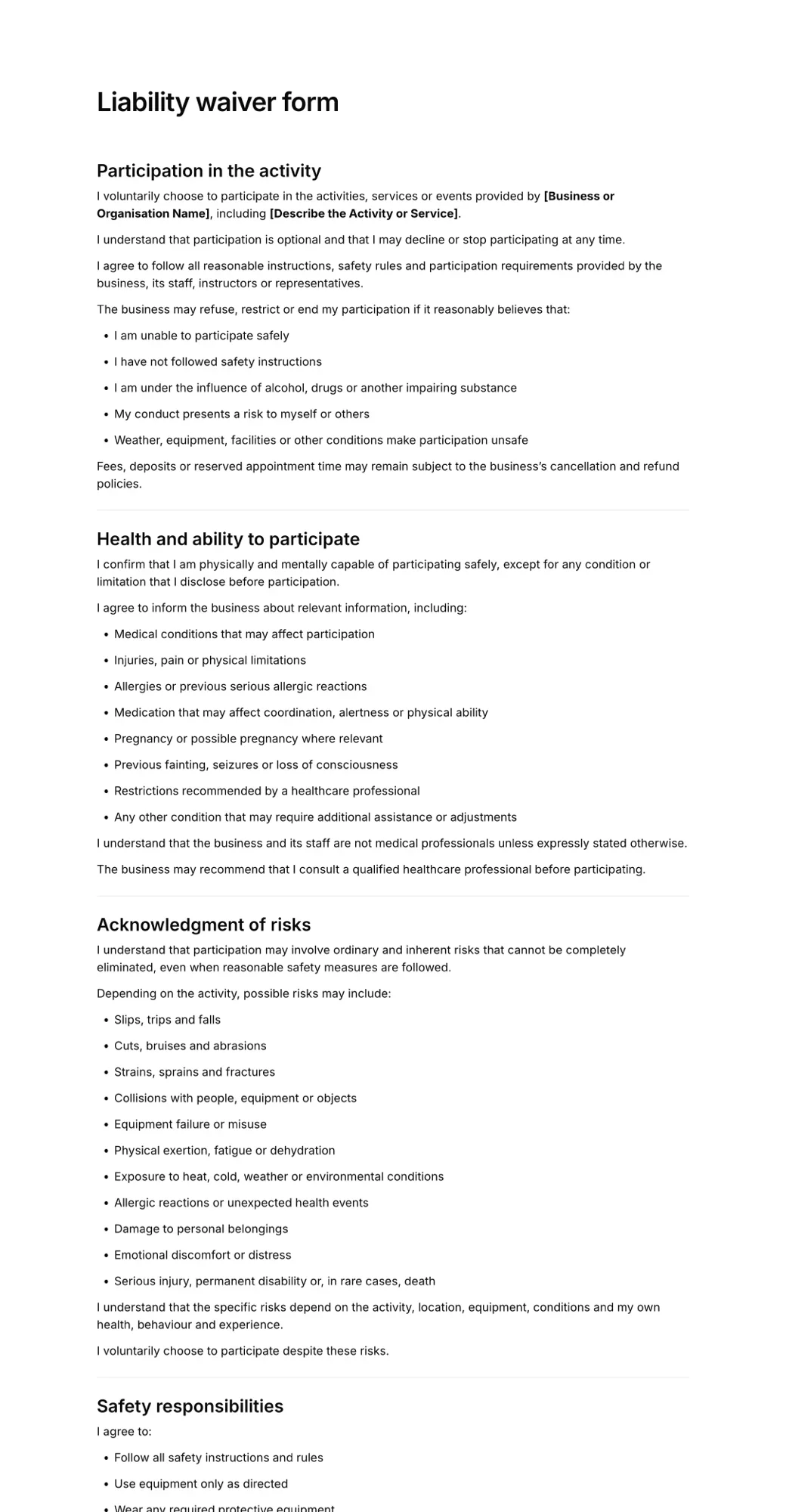
Sign here
