

A personal training liability waiver is the document a client signs before training with you. It explains the risks of exercise, records the client's health disclosures, and sets out what they agree to before the first session.
Whether you train clients in a gym, a private studio, their home, a park or over video, every session involves physical exertion and some risk of injury. A clear waiver helps you communicate those risks, collect the health information you need to plan safe sessions, and keep a dated record of what each client agreed to.
This guide explains what a personal training liability waiver is, what it should include, how it differs for online and in-home training, and how to collect personal trainer waivers online. It is general information, not legal advice. Waiver rules differ between countries and states, so have your final wording reviewed for where you work.
What is a personal training liability waiver?
A personal training liability waiver, sometimes called a personal trainer waiver or fitness training release form, is an agreement between a trainer or training business and a client. By signing it, the client confirms that they:
- understand that exercise and fitness training carry a risk of injury
- choose to take part voluntarily
- have disclosed health conditions, injuries and medications that could affect training
- will follow the trainer's instructions and work within their own limits
- release the trainer from certain claims, to the extent the law allows
Most personal training waivers combine several parts in one document: an assumption of risk, a health declaration, a release of liability, and the client's signature. Many trainers also add their session policies, such as cancellations and late arrivals, so the client agrees to everything at once.
If you want the wider background on how waivers work, our guide to liability waivers covers the basics for every type of business.
Do personal trainers need a liability waiver?
In most places no law requires a personal trainer to use a waiver, but it is standard practice, and many gyms, studios and insurers expect trainers to have one. A waiver helps you:
- Set expectations before training starts, so clients know the physical demands and their own responsibilities.
- Collect health information that affects how you program sessions.
- Document consent with a dated, signed record you can find later.
- Support your insurance and risk management, alongside proper certification, safe equipment and good coaching practice.
A waiver does not make you immune from every claim. Courts in many jurisdictions will not enforce a waiver against gross negligence or reckless conduct, and some places limit waivers more broadly. Think of it as one part of your risk management, together with qualifications, insurance, safe programming and clear communication.
Who should use a personal training waiver?
A personal training liability waiver fits anyone coaching individual clients or small groups, including:
- independent personal trainers working in a commercial gym
- private training studios and boutique fitness studios
- mobile and in-home personal trainers
- online and hybrid coaches running video sessions
- strength and conditioning coaches
- bootcamp and small-group outdoor trainers
- sports performance and athletic coaches
If you train clients inside someone else's gym, that gym's membership waiver usually covers its facility, not your coaching. Check your arrangement with the gym and use your own waiver for the training you provide.
What should a personal training liability waiver include?
Every waiver should be written for your services, but most personal trainer waivers cover the sections below.
1. Client information
Collect the details you need to identify the client and contact them:
- full name
- date of birth
- phone number and email
- emergency contact name and phone number
Keep it to what you will actually use.
2. Description of the training services
Describe what the client is signing up for, for example:
- one-to-one or small-group personal training
- strength and resistance training, including free weights and machines
- cardiovascular and interval training
- mobility, stretching and bodyweight exercise
- outdoor sessions, in-home sessions or online video sessions
A specific description helps the client understand exactly which activities the waiver covers.
3. Acknowledgement of exercise risks
Name the realistic risks of training in plain language rather than relying on general wording. Common examples include:
- muscle strains, sprains and soreness
- joint, back and other musculoskeletal injuries
- injuries from lifting, dropping or misusing equipment
- falls and trips during exercise
- dizziness, fainting or nausea from exertion
- in rare cases, cardiovascular events such as heart attack
4. Voluntary participation and assumption of risk
The client confirms that they take part voluntarily, understand the risks described, and accept responsibility for the risks that are inherent in exercise and cannot reasonably be removed.
5. Health declaration and medical clearance
This is the section that makes a personal training waiver different from a simple gym waiver. Ask the client to disclose anything that could affect their training, such as:
- heart, blood pressure or breathing conditions
- diabetes, epilepsy or other medical conditions
- recent surgery, injuries or chronic pain
- pregnancy or recent childbirth
- medications that affect heart rate, balance or energy
Many trainers use a pre-exercise screening questionnaire such as the PAR-Q+ for this, or include similar questions directly in the waiver. Add a statement that the client will get clearance from a doctor if the screening suggests they should, and will tell you if their health changes during the training period.
6. Client responsibilities
Set out what the client agrees to do during sessions:
- follow the trainer's instructions and technique cues
- stop and tell the trainer if they feel pain, dizziness or discomfort
- work within their own limits
- wear suitable clothing and footwear
- not train under the influence of alcohol or drugs
7. Release of liability
The release states that the client gives up certain claims against the trainer or business arising from ordinary risks of training, to the extent permitted by law. Keep the wording clear and visible rather than buried in small print, and avoid claiming more than the law where you work allows.
8. Emergency medical treatment
Allow the trainer to call emergency services or arrange first aid if the client is injured or unwell, and note who is responsible for the cost of any treatment.
9. Session policies (optional)
Many trainers include their business policies in the same signed form:
- cancellation and late-arrival rules
- package expiry and refunds
- photo and video consent for progress tracking or social media
10. Agreement checkbox and signature
Finish with a checkbox confirming the client has read and understood the waiver, followed by their signature and the date. With digital waivers the signing date and time can be recorded automatically.
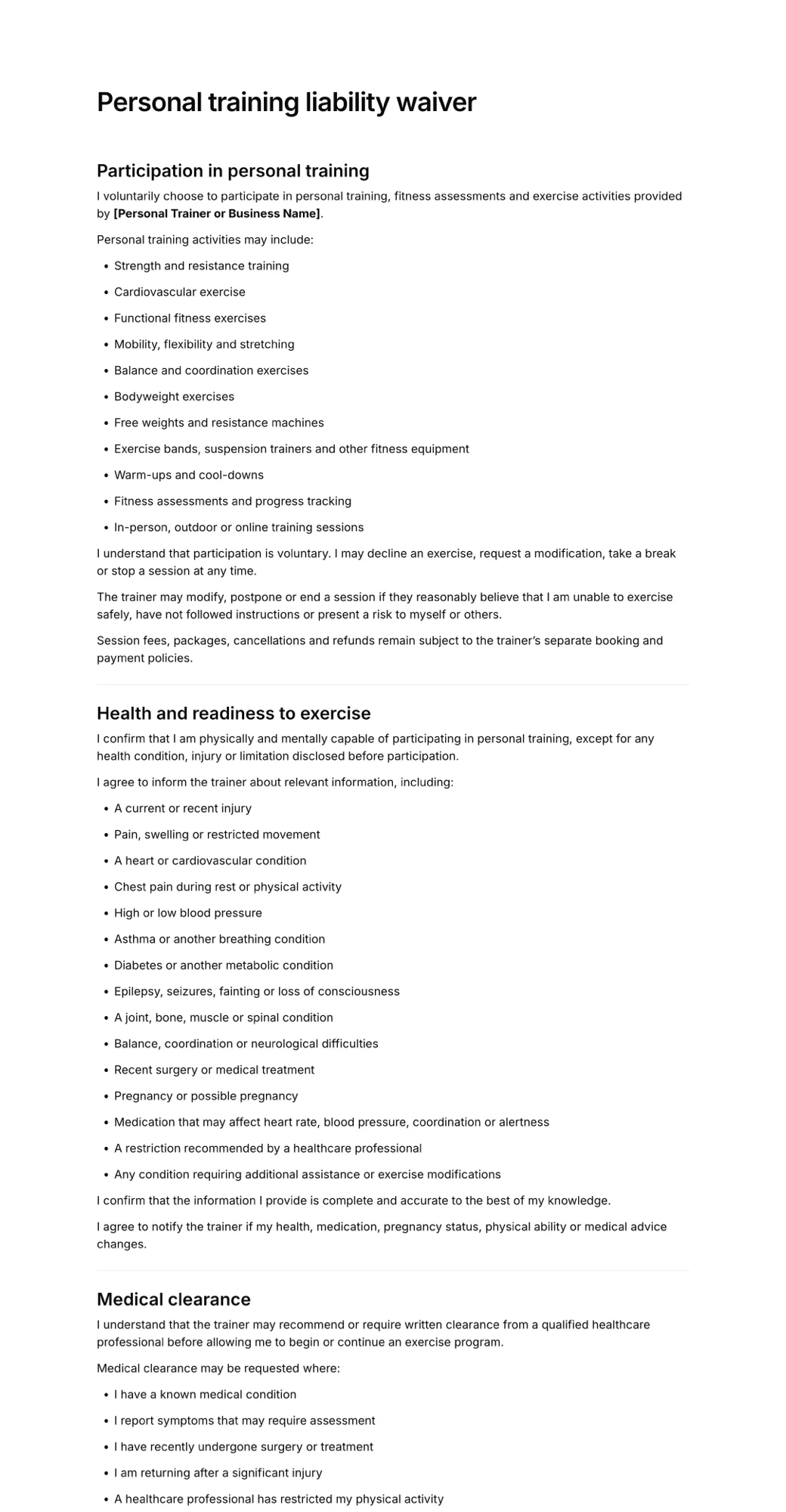
Personal training waiver sample structure
Here is a simple outline you can adapt. Replace the bracketed details with your own and adjust each section to your services and location.
Personal Training Waiver and Release of Liability
Client details: name, date of birth, phone, email and emergency contact.
Services: I am taking part in personal training sessions with [Trainer or Business Name], which may include strength, cardiovascular, mobility and bodyweight exercise, in person, outdoors or online.
Risks: I understand that exercise involves a risk of injury, including strains, sprains, falls, equipment-related injuries and, in rare cases, serious medical events.
Health declaration: I have answered the health questions truthfully, will seek medical clearance where advised, and will tell my trainer about any change in my health.
Responsibilities: I will follow instructions, work within my limits, and stop and tell my trainer if I feel pain or discomfort.
Release: To the extent permitted by law, I release [Trainer or Business Name] from claims arising from the ordinary risks of training.
Emergency care: I authorise my trainer to call emergency services if needed.
Agreement: I have read and understood this waiver and agree to its terms.
Signature and date.
Waivers for online and in-home personal training
Training outside a gym changes the risks, so update the waiver to match.
Online training. You can't spot the client or check their space in person. Ask the client to confirm that their training area is clear and safe, that their equipment is in good condition, that someone can reach them in an emergency, and that they will stop if the video connection drops during a demanding exercise.
In-home training. You are working in the client's space with their floors, furniture and equipment. Add a statement that the client is responsible for the condition of their home and equipment, and agree what happens if a session can't go ahead safely.
Outdoor training. Mention weather, uneven ground, traffic and other park users, and who decides whether a session goes ahead in bad conditions.
Personal training waivers for minors
If you train clients under 18, the waiver should be signed by a parent or legal guardian. Collect the child's details, the guardian's name and relationship, and the guardian's consent and signature.
Whether a parent can waive particular claims on a child's behalf varies by jurisdiction, and in some places the release part may not be enforceable for minors at all. The waiver is still valuable for health disclosures, consent and emergency contacts, but check your local rules and insurance requirements.
Common mistakes in personal trainer waivers
- Generic wording. A copied gym waiver may not describe personal training, online sessions or in-home training at all.
- No health screening. Skipping health questions means you plan sessions without key information.
- Hiding the release. Small print or vague phrasing makes it less likely the client understood what they signed.
- Overclaiming. Wording that tries to excuse any behaviour, including gross negligence, can undermine the whole document in some places.
- Never updating it. Re-check your waiver when you add new services or locations, and ask clients to update their health information when it changes.
- Losing paper forms. A waiver only helps if you can find it later.
For a longer list, see what makes a liability waiver invalid.
Paper vs online personal training waivers
Paper forms work for a handful of clients, but they are easy to lose, hard to read and inconvenient for online or mobile trainers. An online personal training waiver lets clients:
- sign before the first session from their phone, tablet or computer
- answer health questions in their own time instead of at the start of a paid session
- sign remotely if you coach online
And it gives you a signed record you can open whenever you need it, without scanning or filing paper.
How to create a personal training waiver online
Here is how to set one up with AgreeDock:
Step 1: Start from a template or AI
Open the personal training liability waiver template, or describe your coaching business to the AI waiver generator and get a tailored first draft.
Step 2: Customise the wording
Add your business name, the services you offer, your locations, and your session policies. Rewrite any section so it matches how you train.
Step 3: Add health and contact fields
Include contact details, an emergency contact, health questions with checkboxes and free-text answers, and an agreement checkbox above the signature.
Step 4: Share the signing link or QR code
Send the link in your welcome email or booking confirmation, or show the QR code at the gym or studio so new clients can sign on their phone.
Step 5: Review signed waivers
Every signed waiver appears in your Signatures list with the client's answers and the exact wording they agreed to. You can download each signed waiver as a PDF.
Training in a gym or studio of your own? See how gyms and fitness studios use AgreeDock for waivers and intake forms.
Frequently asked questions
What is a personal training liability waiver?
A personal training liability waiver is an agreement a client signs before training. It explains the risks of exercise, records the client's health disclosures, confirms they take part voluntarily, and releases the trainer from certain claims to the extent the law allows.
Do personal trainers legally need a waiver?
In most places there is no law requiring personal trainers to use a waiver, but it is standard practice and often expected by gyms and insurers. It helps you set expectations, collect health information and keep a signed record of what each client agreed to.
What should a personal trainer waiver include?
Most include client and emergency contact details, a description of the training, the risks of exercise, an assumption of risk, a health declaration, client responsibilities, a release of liability, emergency treatment consent, and a signature with the date.
Is a personal training waiver the same as a gym waiver?
Not quite. A gym waiver mainly covers use of the facility and equipment. A personal training waiver covers your coaching and programming, usually includes more detailed health screening, and should reflect where you train, such as online, outdoors or in clients' homes.
Does a waiver protect a personal trainer from all claims?
No. A waiver can reduce risk, but many jurisdictions will not enforce it against gross negligence or reckless conduct, and some limit waivers further. Use it alongside proper qualifications, insurance and safe coaching practices.
Can clients sign a personal training waiver online?
Yes. Electronic signatures are recognised in many countries, including under the ESIGN Act and UETA in the United States. Clients can review the waiver, answer the health questions and sign on their own device before the first session.
Should a personal training waiver include a PAR-Q?
Many trainers include a pre-exercise screening questionnaire such as the PAR-Q+ or similar health questions, because they help identify clients who should get medical clearance first. You can include the questions in the same signed form.
How often should clients sign a new waiver?
Many trainers ask for a new waiver when they change their services or wording, when a client's health changes significantly, or once a year. The right schedule depends on your business, insurance and local requirements.