

A waiver for minors is a liability waiver or consent form that a parent or legal guardian signs on behalf of a child under 18. It covers the activity's risks, the child's health information, emergency contacts and the parent's consent for the child to take part.
Camps, trampoline parks, sports clubs, dance studios, party venues and many other businesses work with children every day, and almost all of them ask a parent to sign something first. But a waiver for a child works differently from a waiver for an adult, and the most common question is simple: can a parent actually sign away a child's rights?
This guide explains how waivers for minors work, what the law generally says about parental waivers, what a minor waiver form should include, and how to collect parent signatures online. It is general information, not legal advice. The rules on waivers for children vary a lot between countries and states, so have your final form reviewed for where you operate.
What is a waiver for minors?
A waiver for minors, also called a minor waiver form, parental waiver or youth participation waiver, is a document signed by a parent or legal guardian before a child takes part in an activity. It usually:
- describes the activity and its risks
- records the child's details, health information and allergies
- gives emergency contacts and permission for emergency treatment
- confirms the parent's consent for the child to participate
- includes a release of liability and, sometimes, an indemnity from the parent
Because a child generally cannot enter into a binding contract on their own, the person signing is the parent or guardian, not the child.
Can a minor sign a liability waiver?
In most places, no. A person under 18 usually lacks the legal capacity to be bound by a contract, and many legal systems allow a minor to back out of a contract they signed. A waiver signed only by a child is therefore unlikely to protect your business.
That is why waivers for activities involving children are signed by a parent or legal guardian. Some businesses also ask older children or teenagers to sign alongside the parent to show they have read the safety rules. That can be useful for setting expectations, but it does not replace the parent's signature.
Can a parent sign a waiver for a child?
Yes, a parent can sign a waiver for their child, and it is standard practice. The harder question is how much of it a court will enforce.
A minor waiver form usually does several jobs at once, and they are treated differently:
- Consent and information. The parent's permission for the child to take part, health disclosures, emergency contacts and consent to emergency treatment are widely accepted and very useful.
- Release of the child's claims. A pre-injury release in which a parent gives up the child's own right to sue is where the law varies most. Some jurisdictions enforce these releases, some enforce them only for certain activities such as community or nonprofit programmes, and many do not enforce them at all.
- The parent's own claims and indemnity. Some forms also release the parent's own claims, or ask the parent to indemnify the business. These clauses have their own rules and are not enforceable everywhere.
Even where the release part may not hold up, a well-written waiver for minors is still worth having. It shows that the parent was told about the risks, it collects the information your staff need, and it gives you a signed record of consent.
Is a waiver for minors legally binding?
Whether a waiver for minors is binding depends on where you operate, the activity, the wording and how it was signed. Courts commonly look at:
- whether the person signing was the parent or legal guardian
- whether the risks were described clearly and specifically
- whether the release wording was clear and visible rather than hidden
- whether the activity was recreational, educational, commercial or community-run
- whether the injury came from an inherent risk of the activity or from negligence
No waiver protects a business from every claim. Waivers generally cannot excuse gross negligence or reckless conduct, and some places limit them further for children. Combine your waiver with good supervision, trained staff, safe equipment and the right insurance.
What should a minor waiver form include?
Here are the sections most waivers for minors cover.
1. Child's information
- child's full name
- date of birth or age
- any group, session or class they are booked into
2. Parent or guardian information
- parent or guardian's full name
- relationship to the child
- phone number and email
- confirmation that they are the child's parent or legal guardian
3. Description of the activity
Describe what the child will do, where and when: for example a week of day camp with swimming and hiking, a trampoline park session, a dance class or a party. The more specific, the easier it is for the parent to understand what they are agreeing to.
4. Risks of the activity
List the realistic risks in plain language, such as falls, collisions, sprains, broken bones, sunburn, water-related risks or allergic reactions. Specific risks are clearer to parents than generic wording.
5. Medical information and allergies
- allergies and dietary needs
- medical conditions and medications
- anything staff should know about behaviour, mobility or support needs
Only collect what your staff actually need, and store it appropriately.
6. Emergency contacts and medical consent
Collect at least one emergency contact other than the signing parent, and ask for consent for staff to arrange first aid or emergency medical treatment if the parent can't be reached.
7. Rules and supervision
Explain the rules the child must follow and what supervision you provide. For drop-off activities, cover pick-up arrangements and who is allowed to collect the child.
8. Photo and media consent
If you take photos or videos, ask separately whether you may use images of the child, and keep it optional.
9. Release of liability
Include a clearly worded release, written for your jurisdiction. Avoid wording that tries to excuse any conduct at all, which can undermine the whole document in some places.
10. Parent agreement and signature
Finish with a checkbox confirming the parent has read and understood the form, followed by the parent's signature and the date.
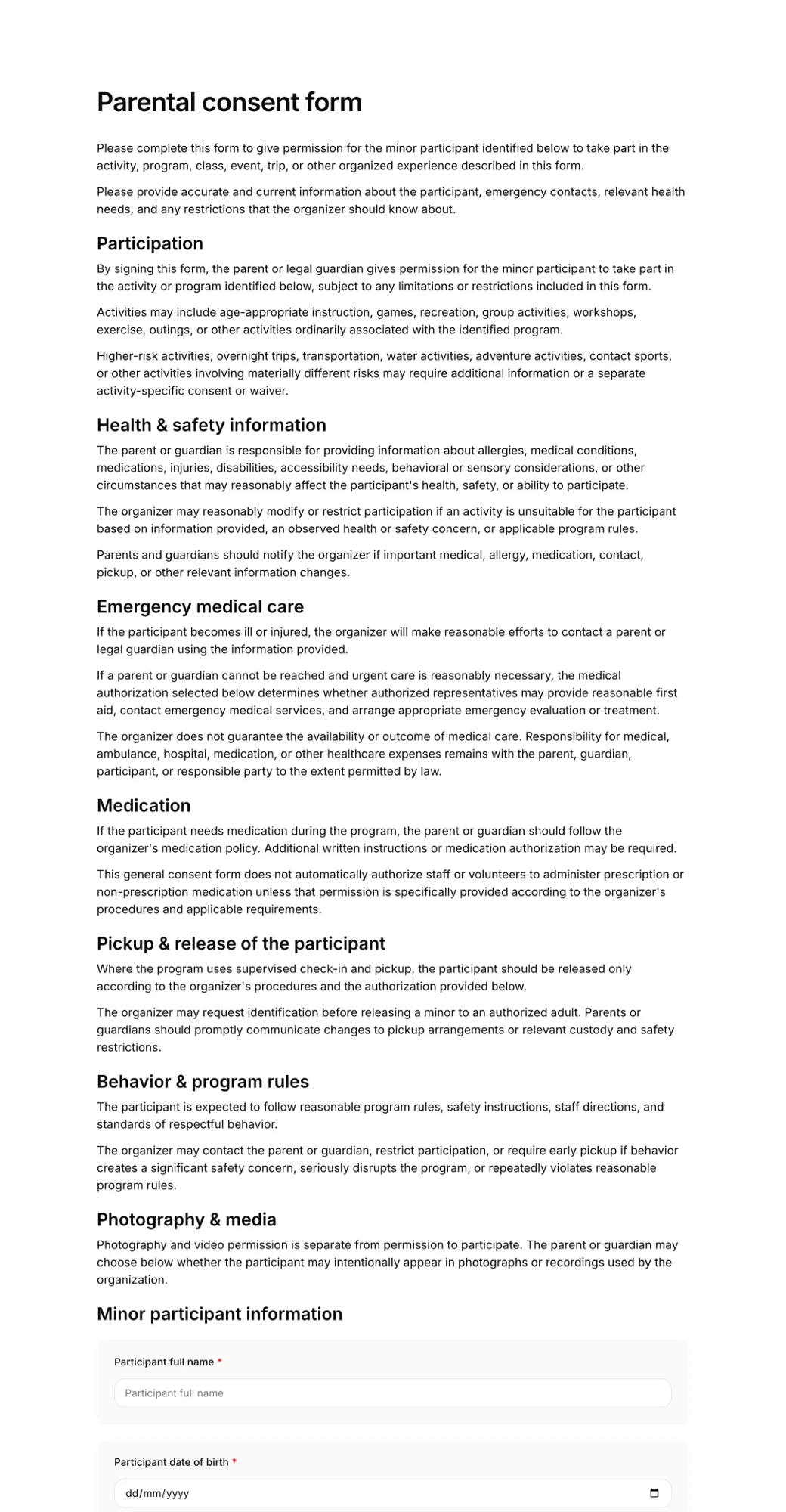
Minor waiver form sample structure
Use this outline as a starting point and adapt each section to your activity and location.
Parent or Guardian Consent and Release for a Minor
Child: full name, date of birth, session or group.
Parent or guardian: full name, relationship to the child, phone and email.
Activity: I give permission for my child to take part in [activity] at [Business Name] on [dates].
Risks: I understand that this activity involves risks, including [specific risks], and I have explained the safety rules to my child.
Health: I have listed my child's allergies, medical conditions and medications, and will tell [Business Name] about any changes.
Emergency care: If I cannot be reached, I authorise staff to arrange first aid or emergency medical treatment for my child.
Photos (optional): I do / do not give permission for photos or videos of my child to be used by [Business Name].
Release: To the extent permitted by law, I release [Business Name] from claims arising from the ordinary risks of this activity.
Agreement: I am the parent or legal guardian of this child, I have read this form, and I agree to its terms.
Parent or guardian signature and date.
Waivers for minors by activity
The basics stay the same, but each type of business emphasises different parts.
- Summer camps and retreats. Detailed medical, allergy and dietary information, emergency contacts, pick-up permissions and photo consent. See our summer camp liability waiver.
- Trampoline parks and activity centres. Clear risks, park rules, supervision and quick signing for busy sessions. See the trampoline park waiver.
- Sports clubs and martial arts. Contact and physical risks, training rules, and consent for travel to games or competitions.
- Dance studios and classes. Participation risks, studio rules and photo consent for shows and social media.
- Parties and events. One form per child, signed by each parent before the party starts.
- Travel without both parents. A minor travel consent form is a different document: it gives permission for a child to travel, rather than releasing liability for an activity.
How long is a parental waiver valid?
There is no single rule. Many businesses ask parents to sign a new waiver for each programme, season or school year, or whenever the activity changes. If a child's health changes, ask the parent to update their information. When you edit your waiver, make sure each signed copy still shows the exact version the parent agreed to.
Common mistakes with waivers for minors
- Letting the child sign instead of a parent. A child's signature alone generally doesn't bind anyone.
- One form for several children. Ask for a separate form per child, so each record holds that child's own details and health information.
- Generic risk wording. An adult gym waiver copied for a kids' class won't describe the real activity.
- Not checking who signed. Ask the signer to confirm they are the parent or legal guardian.
- Skipping emergency consent. If something happens, staff need to know whom to call and what they are allowed to do.
- Losing paper forms. A form only helps if you can find it when you need it.
For more pitfalls, read what makes a liability waiver invalid.
How to collect parental waivers online
Paper forms at the front desk slow down drop-off and are easy to lose. With AgreeDock, parents sign on their own phone before they arrive:
Step 1: Start from a template or AI
Use the parental consent form or summer camp waiver template, or describe your programme to the AI waiver generator to get a draft written for your activity.
Step 2: Add child, parent and health fields
Add fields for the child's name and date of birth, the parent's details and relationship, allergies and medical information, emergency contacts, and an agreement checkbox above the parent's signature.
Step 3: Send the link before the activity
Include the signing link in your booking or registration confirmation, and display the QR code at check-in for anyone who hasn't signed yet.
Step 4: Check signatures before arrival
Every signed form appears in your Signatures list with the parent's answers and the exact wording they agreed to, and you can download each one as a PDF.
Running a camp or activity business? See how camps and retreats and activity businesses collect waivers with AgreeDock.
Frequently asked questions
Can a parent sign a liability waiver for a child?
Yes. Parents and legal guardians sign waivers for children all the time, and it is the standard way to collect consent, health information and emergency contacts. Whether the release of the child's own claims is enforceable depends on where you operate and the type of activity, so have your wording reviewed locally.
Can a minor sign a waiver themselves?
Generally no. Most legal systems treat people under 18 as unable to be bound by contracts like waivers. A waiver for a child should be signed by a parent or legal guardian. Some businesses ask teenagers to sign as well to acknowledge the rules, but that does not replace the parent's signature.
Are waivers for minors enforceable?
It varies. Some jurisdictions enforce parental releases, some only for certain activities, and many do not enforce a parent's release of a child's claims. Even then, the consent, health information and emergency sections of a minor waiver form remain useful. No waiver covers gross negligence.
What should a waiver for minors include?
Include the child's details, the parent or guardian's details and relationship, a description of the activity and its risks, medical information and allergies, emergency contacts and treatment consent, rules and supervision, optional photo consent, a release of liability, and the parent's signature and date.
Does each child need a separate waiver?
It is best practice. A separate form for each child keeps their medical information, allergies and emergency contacts in their own record, and makes it clear which child the parent consented for.
Can a grandparent or babysitter sign a waiver for a child?
Usually only a parent or legal guardian should sign. Another adult may not have legal authority to give consent or release claims for the child. If you allow other carers to sign, check your local rules and your insurer's requirements first.
Can parents sign a waiver for minors online?
Yes. Electronic signatures are recognised in many countries, including under the ESIGN Act and UETA in the United States. Parents can review the form and sign on their phone before the activity, and you keep a signed record of each form.
How often should parents sign a new waiver?
Many businesses ask for a new waiver for each programme, season or school year, or when the activity or wording changes. Ask parents to update the form whenever their child's health information changes.